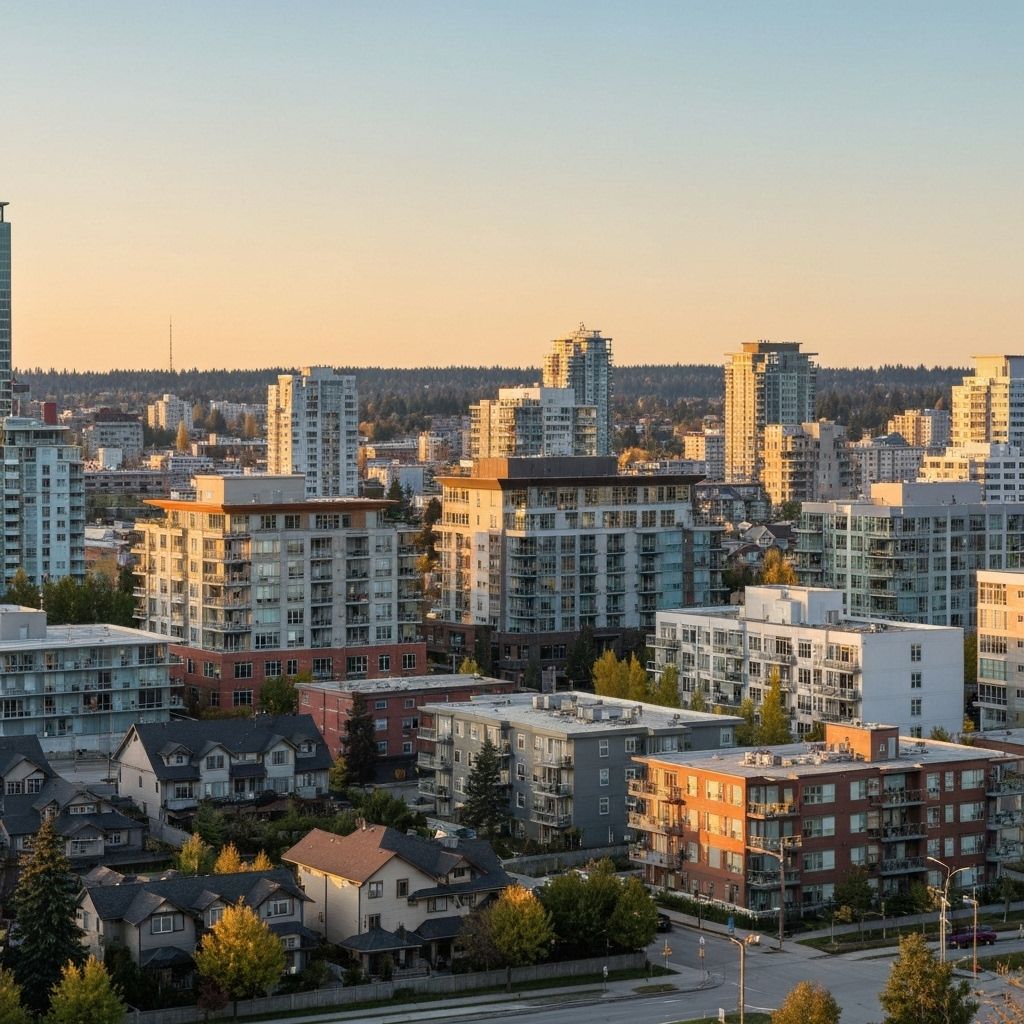
Investment Property Mortgages in BC
Build wealth through real estate. Get competitive financing for rental properties, multi-unit buildings, and your growing investment portfolio.
Turn Real Estate Into Passive Income
Investment properties are one of the most proven wealth-building strategies in British Columbia. Whether you're purchasing your first rental property or expanding an existing portfolio, the right mortgage financing can make the difference between a good investment and a great one.
At Legacy Mortgage Group, Harpreet Sandhu specializes in investment property financing across the Lower Mainland. With access to over 50 lenders—including traditional banks, credit unions, and private lenders—we find competitive rates and flexible terms that maximize your cash flow and return on investment.
From single-family rentals to multi-unit buildings, from your first property to your tenth, we guide you through every step of the financing process. Our expertise in BC's rental market regulations, tax implications, and portfolio strategies ensures you make informed decisions that align with your long-term wealth goals.
Who Benefits from Investment Property Financing?
First-Time Investors
Ready to purchase your first rental property and start building passive income streams.
Portfolio Builders
Experienced investors looking to expand their real estate holdings with strategic financing.
Cash Flow Seekers
Investors focused on positive monthly cash flow from rental income to supplement their income.
Wealth Preservers
Those seeking to diversify investments and build long-term wealth through real estate appreciation.
Multi-Unit Buyers
Investors purchasing duplexes, triplexes, or small apartment buildings for economies of scale.
BRRRR Strategists
Investors using the Buy-Renovate-Rent-Refinance-Repeat strategy to scale their portfolio quickly.
Your Investment Property Financing Journey

Investment Strategy Consultation
We start by understanding your investment goals, risk tolerance, and timeline. Are you focused on cash flow, appreciation, or both? How many properties do you plan to acquire? What's your target return on investment? This conversation shapes our entire financing strategy and helps us identify the best mortgage products for your specific situation.
Financial Assessment & Pre-Approval
We analyze your income, existing debts, credit score, and down payment to determine your borrowing capacity. For investment properties, we calculate how rental income will offset your mortgage payments and improve your debt service ratios. Most lenders will consider 50-80% of projected rental income when qualifying you. We provide a pre-approval letter that strengthens your offers and shows sellers you're a serious buyer.
Property Analysis & Due Diligence
Once you've identified a property, we help you analyze the numbers. What's the expected rental income? What are the operating expenses (property tax, insurance, maintenance, property management)? What's your cash-on-cash return? We coordinate with appraisers to confirm the property value and ensure it meets lender requirements. For multi-unit properties, we review rent rolls and operating statements to verify income.
Lender Selection & Rate Negotiation
With access to over 50 lenders, we compare rates, terms, and features to find the best fit. Some lenders offer better rates for experienced investors. Others specialize in multi-unit properties or portfolio financing. We negotiate on your behalf to secure competitive rates and favorable terms like portable mortgages, assumability, and prepayment privileges that give you flexibility as your portfolio grows.
Documentation & Underwriting
We guide you through gathering required documents: proof of income (T1 Generals, NOAs, pay stubs), down payment verification, credit report, property details, and rental income documentation (lease agreements or rental appraisal). For existing landlords, we'll need mortgage statements and property tax bills for your current properties. We submit your complete application to the lender and manage the underwriting process, addressing any questions or conditions promptly.
Closing & Portfolio Planning
We coordinate with your lawyer, realtor, and the lender to ensure a smooth closing. On possession day, your mortgage funds are released and you become a property owner. But our relationship doesn't end there. We provide ongoing support for refinancing, portfolio expansion, and rate renewals. As your properties appreciate and you build equity, we help you leverage that equity to acquire additional properties and accelerate your wealth-building journey.
Investment Property Financing in British Columbia
Down Payment Requirements
Investment properties require a minimum 20% down payment in BC, as they don't qualify for CMHC insurance. Many lenders prefer 25-35% down, especially for first-time investors or properties with lower rental yields. A larger down payment reduces your mortgage amount, improves cash flow, and may qualify you for better rates.
- 20% minimum: Required for most investment properties with A-lenders
- 25-35% preferred: Better rates and terms for larger down payments
- Equity from existing properties: Can be used via refinance or HELOC
Rental Income Qualification
Lenders in BC typically allow 50-80% of projected or actual rental income to offset your mortgage payment when calculating debt service ratios. The exact percentage depends on whether the property is already tenanted, the property type, and the lender's policies. This rental income offset can significantly improve your borrowing capacity.
- 50% for vacant properties: Based on rental appraisal or market comparables
- 80% for tenanted properties: With existing lease agreement and rental history
- 100% for multi-unit: Some lenders use full rental income for buildings with 5+ units
BC Property Transfer Tax (PTT)
Investment properties in BC are subject to Property Transfer Tax, which is calculated on the purchase price. Unlike owner-occupied homes, investment properties don't qualify for the first-time buyer exemption. Budget for this significant upfront cost when planning your purchase.
- 1% on first $200,000: $2,000 maximum on this portion
- 2% on $200,000-$2,000,000: Up to $36,000 on this portion
- 3% on amount over $2,000,000: Plus additional 2% foreign buyer tax if applicable
Residential Tenancy Act Compliance
BC's Residential Tenancy Act governs landlord-tenant relationships and includes strict rules about rent increases, evictions, security deposits, and property maintenance. Understanding these regulations is crucial for successful property management and avoiding costly disputes.
- Annual rent increases: Limited to inflation rate (typically 2-3% per year)
- Security deposits: Maximum 50% of first month's rent, must be held in trust
- Eviction rules: Strict notice periods and valid reasons required for ending tenancy
Real Investment Property Scenarios
Scenario 1: First-Time Investor – Single-Family Rental
Situation: Sarah, a 32-year-old teacher in Surrey, wants to purchase her first investment property—a single-family home in Langley priced at $850,000. She has $200,000 saved (23.5% down) and earns $85,000 annually. The property is expected to rent for $3,200/month.
Solution: We secure a 5-year fixed mortgage at 5.79% with a lender that allows 50% of projected rental income ($1,600/month) to offset the mortgage payment. Her mortgage amount is $650,000 with monthly payments of $3,950. After accounting for rental income offset, property taxes ($3,500/year = $292/month), insurance ($150/month), and maintenance reserve ($200/month), her net monthly cost is approximately $992.
Outcome: Sarah's property generates positive cash flow of $2,208/month ($3,200 rent - $992 net cost). Over 5 years, she pays down $52,000 in principal while the property appreciates an estimated 4% annually ($170,000 total appreciation). Her total wealth increase: $222,000 in 5 years, plus ongoing monthly cash flow.
Scenario 2: Portfolio Expansion – Using Equity to Buy Second Property
Situation: Michael owns a rental condo in Burnaby purchased 5 years ago for $550,000 (now worth $725,000) with a remaining mortgage of $380,000. He wants to purchase a second investment property—a townhouse in Coquitlam for $750,000—but doesn't have enough cash for the down payment.
Solution: We refinance Michael's existing condo to 80% LTV ($580,000), pulling out $200,000 in equity. He uses $150,000 as a 20% down payment on the townhouse and keeps $50,000 as a reserve fund. The townhouse rents for $3,400/month. His new condo mortgage is $580,000 at 5.49% ($3,350/month), and his townhouse mortgage is $600,000 at 5.89% ($3,650/month).
Outcome: Michael now owns two properties with a combined value of $1,475,000 and total mortgages of $1,180,000 (equity: $295,000). His rental income is $6,200/month total, covering both mortgages plus expenses. He's building equity in two appreciating properties simultaneously, accelerating his wealth-building timeline significantly.
Scenario 3: Multi-Unit Investment – Duplex Purchase
Situation: Jennifer and David, a couple in their 40s, want to purchase a duplex in New Westminster for $1,100,000. Each unit rents for $2,400/month ($4,800 total). They have $300,000 for a down payment (27%) and combined income of $160,000.
Solution: We secure financing with a lender that allows 80% of rental income ($3,840/month) to offset the mortgage payment. Their mortgage is $800,000 at 5.69% with monthly payments of $4,850. After rental income offset, property taxes ($4,200/year = $350/month), insurance ($200/month), and maintenance ($300/month), their net monthly cost is approximately $1,560.
Outcome: The duplex generates positive cash flow of $3,240/month ($4,800 rent - $1,560 net cost). The couple benefits from economies of scale—one property, one mortgage, but double the rental income. Over 25 years, tenants pay off the entire mortgage while the property appreciates, creating substantial wealth for retirement.
Scenario 4: BRRRR Strategy – Value-Add Investment
Situation: Alex, an experienced investor, finds a dated single-family home in Maple Ridge for $650,000 that needs $80,000 in renovations. After renovations, the property will be worth $850,000 and rent for $3,000/month. He has $200,000 available for the purchase and renovations.
Solution: We arrange initial financing of $520,000 (80% of purchase price) at 6.29% through a B-lender that allows renovations. Alex uses $130,000 for the down payment and $80,000 for renovations (total: $210,000). After 6 months of renovations and tenant placement, we refinance at 80% of the new appraised value ($850,000 × 80% = $680,000) with an A-lender at 5.79%.
Outcome: Alex pulls out $160,000 in the refinance ($680,000 new mortgage - $520,000 old mortgage), recovering most of his initial $210,000 investment. He now owns a property worth $850,000 with a mortgage of $680,000 (equity: $170,000) and only $50,000 of his own money tied up. The property generates $3,000/month in rent, covering the mortgage and expenses. He can now repeat this strategy with another property.
Investment Property Mortgage Options Compared
| Feature | A-Lender (Bank/Credit Union) | B-Lender (Alternative) | Private Lender |
|---|---|---|---|
| Interest Rate | 5.5-6.5% | 6.5-9% | 8-12% |
| Down Payment | 20-25% minimum | 20-35% minimum | 25-35% minimum |
| Credit Score Required | 680+ preferred | 600-680 | No minimum (equity-based) |
| Income Verification | Full documentation required | Stated income options available | Minimal or none |
| Approval Time | 7-14 days | 3-7 days | 1-3 days |
| Best For | Strong credit, stable income, long-term hold | Self-employed, credit challenges, quick closing | Short-term bridge, renovations, credit issues |
Portfolio Financing
Own 5+ properties? Ask about specialized portfolio financing with flexible terms and competitive rates for experienced investors.
Cash Flow Analysis
We provide detailed cash flow projections including all expenses, vacancy rates, and maintenance costs to ensure positive returns.
Tax Strategy Guidance
Understand tax implications of rental income, capital gains, and deductions. We connect you with qualified accountants.
Investment Property Mortgage FAQs
How much down payment do I need for an investment property in BC?
For investment properties in BC, you typically need a minimum 20% down payment. This is higher than owner-occupied properties because lenders view rental properties as higher risk. Some lenders may require 25-35% down depending on the property type and your financial profile.
Can I use rental income to qualify for an investment property mortgage?
Yes, most lenders will consider 50-80% of the projected or actual rental income when calculating your debt service ratios. The exact percentage depends on the lender and whether the property is already tenanted. You'll need to provide a rental appraisal or existing lease agreement.
What are the mortgage rates for investment properties?
Investment property mortgage rates are typically 0.15-0.50% higher than owner-occupied rates due to the increased risk. Current rates range from approximately 5.5-7.5% depending on your down payment, credit score, property type, and whether you choose fixed or variable terms.
How many investment properties can I finance?
Most traditional lenders (A-lenders) will finance up to 4-5 properties per borrower. Beyond that, you may need to work with B-lenders or private lenders who specialize in portfolio financing. Your ability to qualify depends on your overall debt service ratios and equity position.
What is the stress test for investment properties?
Investment properties are subject to the mortgage stress test, meaning you must qualify at the higher of your contract rate plus 2% or 5.25%. This ensures you can handle rate increases. The stress test applies to both purchases and refinances.
Can I refinance my investment property to buy another one?
Yes, refinancing an investment property to access equity for another purchase is a common strategy. You can typically refinance up to 80% LTV on rental properties. The equity pulled out can be used as a down payment for your next investment property.
What documents do I need for an investment property mortgage?
You'll need: proof of income (T1 Generals, NOAs, pay stubs), down payment verification, credit report, property details, rental income documentation (lease agreements or rental appraisal), existing mortgage statements, and property tax bills for current properties.
Are there tax benefits to owning investment properties in BC?
Yes, you can deduct mortgage interest, property taxes, insurance, maintenance, property management fees, and depreciation from your rental income. However, you'll pay capital gains tax on 50% of any profit when you sell. Consult a tax professional for personalized advice.
What is the difference between conventional and portfolio financing?
Conventional financing treats each property individually with standard qualification criteria. Portfolio financing considers your entire real estate portfolio and may offer more flexible terms for experienced investors with multiple properties. Portfolio lenders focus on overall cash flow rather than individual property performance.
Can I buy an investment property with bad credit?
Yes, but your options are more limited. With credit scores below 650, you'll likely need to work with B-lenders or private lenders who charge higher rates (7-12%). A larger down payment (30-35%) can help offset credit concerns. Focus on improving your credit while building equity.
What is the BRRRR strategy and how does it work in BC?
BRRRR stands for Buy, Renovate, Rent, Refinance, Repeat. You purchase a property below market value, renovate it to increase value, rent it out, refinance to pull out your initial investment, then repeat. This strategy works well in BC's appreciating market but requires careful planning and financing.
How long does it take to get approved for an investment property mortgage?
Pre-approval typically takes 24-48 hours with complete documentation. Full approval after an accepted offer takes 7-14 days depending on property appraisal and final underwriting. Having your documents organized and working with an experienced broker can significantly speed up the process.
Ready to Build Your Real Estate Portfolio?
Let's discuss your investment goals and find the right financing to make them a reality. Harpreet Sandhu is here to guide you every step of the way.
Harpreet Sandhu is a licensed mortgage broker serving the Lower Mainland, BC. Lic# [LICENSE_NUMBER]. Rates and terms subject to change. All investment property mortgages are subject to lender approval and property appraisal. This information is for educational purposes and does not constitute financial or investment advice. Consult with qualified professionals before making investment decisions.